Showing posts with label Spain. Show all posts

Tuesday, October 15, 2024

King Philip II: Spain's Catholic Monarch and Imperial Powerhouse

King Philip II of Spain, born on May 21, 1527, in Valladolid, was one of the most influential monarchs of the 16th century. He ascended to the Spanish throne in 1556, following the abdication of his father, Emperor Charles V. Philip’s reign, which lasted until his death in 1598, was a defining period for Spain and Europe, characterized by a complex mixture of political, military, and cultural developments.

Philip II was a fervent supporter of Catholicism, and his religious convictions shaped much of his rule. A key player in the Counter-Reformation, Philip sought to restore and strengthen the Catholic Church in response to the growing influence of Protestantism. His efforts included staunch support for the Spanish Inquisition, a religious tribunal aimed at rooting out heresy, and the backing of the Council of Trent, which sought to clarify Catholic doctrine and reform church practices. His dedication to the Catholic cause earned him the title "Most Catholic King" and solidified his role as a defender of the faith throughout Europe.

Under Philip’s leadership, Spain reached the peak of its imperial power. His empire stretched across vast territories, including parts of Europe (such as the Spanish Netherlands and Portugal), the Americas, and even the Philippines in Asia. His global empire made Spain the preeminent European power of the time. However, maintaining such a vast empire also led to significant challenges, especially in terms of military conflicts. The Eighty Years’ War, which began in 1568, saw Philip struggling to suppress the Protestant rebellion in the Netherlands, a conflict that drained Spain's resources. The Spanish Armada, a massive fleet sent to invade Protestant England in 1588, ended in a disastrous defeat, signaling the limits of Spain’s military might.

Despite these setbacks, Philip II’s reign also saw remarkable cultural achievements. The construction of El Escorial, a vast palace and monastery complex, stood as a symbol of both his religious devotion and his authority. This period also marked the height of the Spanish Golden Age, a flourishing of art, literature, and culture, with figures like Cervantes and El Greco emerging during his rule.

Philip II’s legacy is one of contrasts—military failures and imperial overreach, alongside cultural brilliance and steadfast Catholicism. His reign fundamentally shaped the trajectory of Spain and left an indelible mark on European history.
King Philip II: Spain's Catholic Monarch and Imperial Powerhouse

Wednesday, November 9, 2022

Hernán Cortés

Hernán Cortés (1485– December 2, 1547) was the conquistador who became famous for leading the military expedition that initiated the Spanish Conquest of Mexico.

Cortés was the son of Martín Cortés de Monroy and of Doña Catalina Pizarro Altamarino—names of ancient lineage. Cortés (full name Don Hernán Cortés de Monroy y Pizarro Altamirano, Marquis of the Valley of Oaxaca) was born in Medellín, in the province of Extremadura, in the Kingdom of Castile in Spain in 1485, to a family of lesser nobility, Cortés first served as a soldier in an expedition of Cuba led by Diego Velázquez in 1511.

He studied in Salamanca for a time but soon grew restless and left Spain in 1504 to explore the New World. In 1511 he sailed with Diego Velázquez to conquer Cuba. There Velázquez was appointed governor, and Cortés clerk to the treasurer.

In 1519 he was elected captain of the third expedition to the mainland, an expedition which he partly funded.

His enmity with the governor of Cuba Diego Velázquez resulted in the latter calling back the expedition in the last moment, an order which was ignored by Cortés in an act of disobedience. Cortés traveled to Mexico anyway, setting his sights on overthrowing ruler Montezuma II in the Aztec capital of Tenochtitlan.

Cortés arrived with around 500 men, 16 horses, and some cannon. He founded a small settlement that would eventually become the city of Veracruz. Montezuma II's messengers returned to the emperor with the terrifying reports of their encounter with the Spainards: their guns, horses, dogs and their lust for gold.

Hernan Cortés and his men landed on the Mexican coast on April of 1519. Montezuma II sent Cortés gifts of gold and chocolate to welcome the Spanish. Although Montezuma II did not trust Cortés, he also was worried that Cortés was the Aztec god Quetzalcoatl. Aztec mythology said that Quetzalcoatl would come to Earth as a man and Cortés had arrived on Quetzalcoatl's birthday.

The Aztecs eventually drove the Spanish from Tenochtitlan, but Cortés returned to defeat the natives and take the city in 1521. Tenochtitlan at the time was one of greatest civilizations on earth. An Aztec city built on a lake with heigh pyramids along with a network of roads and bridges.

When the Governor of Cuba sent emissaries to arrest Cortés he fought them and won and used the extra troops as reinforcements. Instead he wrote letters directly to the king asking to be acknowledged for his successes instead of punished for mutiny.

Cortés continued to seek opportunities to gain wealth and land. He sent more expeditions out into new areas, including what is present-day Honduras. He spent much of his later years seeking recognition for his achievements and support from the Spanish royal court.

Cortés died in Spain on December 2, 1547.
Hernán Cortés

Wednesday, March 28, 2018

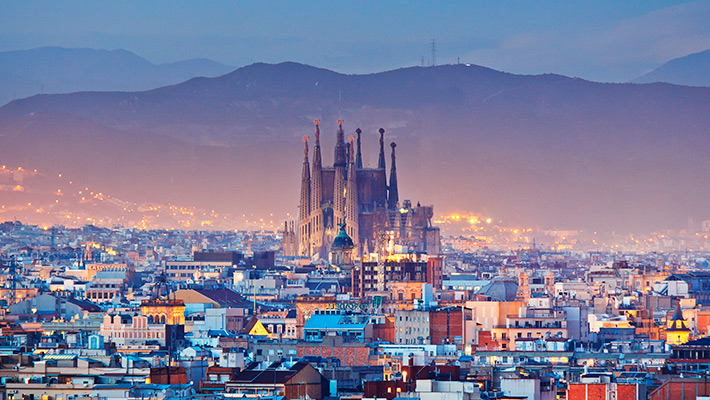
Barcelona: the second largest city in Spain

Barcelona is the capital and largest city of Catalonia, one of the most prosperous regions in southern Europe.

In the first millennium BC, the lands around Barcelona were settled by the agrarian Laetani, while parts of Catalonian were simultaneously colonized by the Iberians. It was the Carthaginians from New Carthage in southern Spain who put Barcelona on the map.

During its history the city has been controlled and fought over by a number of different peoples, including the Visigoths in the 5th century, the Frankish Kings of the 9th century, and the Muslim statesman Al-Mansur in 985.

Barcelona was the Kingdom of Aragon’s major city and chief seaport in the 14th century. Its Catalan language and culture set it apart from Spain and France, but commerce linked it to the Western Mediterranean via coastal roads and its great harbor.

During the 14th and 15th centuries Barcelona was one of the most important centers of gold and silversmithing in Spain.
Barcelona: the second largest city in Spain

Saturday, December 12, 2015

Kingdom of Aragon

Aragon was a kingdom in southeastern Spain, bordering in southern France and the Pyrenees.

In medieval times, the name Aragon also indicated the lands held by the house of Aragon, which included the kingdom of Aragon, Catalonia, Valencia, Majorca and some French fiefs, especially in Provenance, Roussillon and Montpellier.

The principality of Aragon had its origin in 1035, when Sancho III of Navarre left part of the region to his illegitimate son, Ramiro I. Ramiro and his successors, as kings of Aragon, extended the Aragonese territory southward at the expense of the Moorish emirate of Zaragoza.

 Zaragoza, the capital of the Al-Moravod kingdom, fell to Alfonso I of RAgaon in 1118 and the re-conquest of present day Aragon from the Moors was completed by the late twelve century. In 1118 Zaragoza replaced Huesca as the kingdom’s capital.

In the 13th century James I the Conqueror, King Aragon, extended the kingdom by taking control of Valencia and the Balearic islands.

In the 13th – 15th centuries it came to rule Sicily, Sardinia, Naples and Navarra. In 1479 the kingdom of Aragon and Castile were united to form the nucleus of modern Spain. The old kingdom of Aragon survived as an administrative unit until 1833, when it was divided into provinces.
Kingdom of Aragon

Thursday, September 3, 2015

Carthaginians in Spain

Pottery remains from Spain may be the earliest of all those at Carthage for they date to the first half of the 8th century. The occasion of the Carthaginians first landing in Spain, was to assist the inhabitants of Cadiz, who were invaded by the Spaniards.

That city, as well as Utica and Carthage, was a colony of Tyre, and even more ancient than either of them. The success of this first expedition of the Carthaginians, made them desirous of carrying their arms into Spain.

The Carthaginians did not only establish themselves in Spain about this time, but were endeavoring also to subdue the islands of Sicily and Sardinia, but the natives calling in the Romans to their assistance, the Sicilian war proved a very long and bloody one, and Carthaginians were in the end driven from thence.

Carthaginians forces campaigned in south Spain under Hamilcar Barca from 237 BC until his death in battle 229 or 228 BC.

In 237 BC Carthage founded the city of Carthage Nova or New Carthage in the southeast coast, which served as the major Carthaginians sup0ly base on the Iberian Peninsula in a northward expansion.

When Hamilcar Barca was establishing a Carthaginian empire in Spain, the Romans acted the part of mere spectators. On his arrival in Spain, the Carthaginians posses only the coast of Granada and Murcia; but under his administration, Andalusia and the greater part of Valencia seems to have been added to their dominions.

In 206 BC Scipio destroyed the Carthaginians in Spain at Ilipa. The Romans took the war directly to the Carthaginians when, in 204 BC, Scipio invaded North Africa. Hannibal rushed back to defend Carthage and met Scipio at Zama in 202 BC.
Carthaginians in Spain

Articles from other webs