Showing posts with label pasta. Show all posts

Thursday, September 12, 2024

The Croissant: A Symbol of French Culinary Tradition and Cultural Pride

Croissants hold a special place in French culture, symbolizing the country’s rich culinary heritage and artisanal craftsmanship. While the croissant’s origins trace back to Austria, it has become an emblematic French pastry, deeply woven into the fabric of French daily life and identity.

In France, croissants are more than just a breakfast item; they are a quintessential part of the traditional French morning routine. They are typically enjoyed fresh from the bakery, often paired with a cup of coffee or hot chocolate, embodying the French emphasis on quality and freshness. The French take immense pride in their bakery traditions, and the croissant is a prime example of this. Bakeries across France strive to perfect their croissants, which are often made using high-quality butter and flour. The process of making croissants, involving the meticulous lamination of dough and butter, is both an art and a science. Each layer of dough and butter is carefully folded to achieve the pastry’s signature flaky texture. This dedication to culinary precision and excellence reflects the broader values of French cuisine, where attention to detail and craftsmanship are paramount.

Beyond their culinary appeal, croissants also carry historical and symbolic significance. During the French Revolution, the croissant was adopted as a symbol of the revolutionaries’ movement. The crescent shape of the croissant was seen as a nod to the revolutionaries' desire to overcome the old regime, symbolizing resilience and the spirit of the French people. This historical association has helped cement the croissant's place as a symbol of French patriotism and cultural pride.

The croissant’s journey from a simple Austrian pastry to a global icon of French gastronomy underscores its enduring appeal and the influence of French culinary traditions worldwide. As the croissant has traveled beyond France’s borders, it has been embraced in various forms, from traditional plain varieties to innovative fillings and flavors. Whether enjoyed in a Parisian cafĂ© or a bakery halfway around the world, croissants remain a beloved treat that embodies the essence of French culture, representing a blend of tradition, artistry, and national pride.
The Croissant: A Symbol of French Culinary Tradition and Cultural Pride

Thursday, January 27, 2022

Early days of processing pasta in Italy

Pasta was consumed in Italy as early as 600 BC. Italy is generally as home of pasta. Italian pastas namely Macaroni and spaghetti are being traditionally made from semolina flour from durum wheat.

The word "pasta" comes from the Italian word "maccarruni" which means "made into a dough by force". In Italian language maccarruni (macaroni) called as "pasta".

During 1270s, there is a reference to a soldier in the northern Italian city of Genoa, who owned a basket of “macaronis.” A century before, the Muslim geographer al-Idrisi wrote of seeing pasta produced on Sicily. He wrote that the art of making spaghetti or the thinner vermicelli, reached Sicily with the North African caravans in about AD 11oo. On that island they found the essential requisites: hard-grain semolina wheat, sweet water and abundant sun and wind to dry the rolled-out product.

In the 1500s dry pasta manufacturers were founded all over the Italy. The dough was mixed by foot and compressed by 3-4 workers sitting on a long wooden pool. The dough was presses into bronze plate as vermicelli, trennette, lasagnette, farfalle, pennette, conchiglie and other pasta forms, still known today.

Pasta’s great companion, the tomato was bought to Italy by the Spaniards and appears to have been grown in Siena in the 1560s and the Naples area in 1596.

The French Dominican monk Jean-Baptiste Labat (1663–1738), who traveled through Italy at the turn of the 18th century, discovered a flourishing pasta industry there. The combination of the manual brake and the extrusion press, which began to spread in the second half of the 16th century, had revolutionized the production of pasta, considerably increasing output without in any way harming quality.
Early days of processing pasta in Italy 
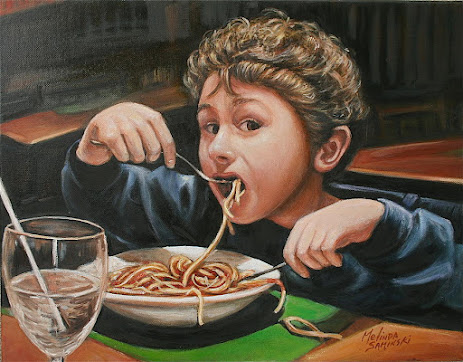
Spaghetti Boy Painting by Melinda Saminski

Articles from other webs