Showing posts with label processing. Show all posts

Thursday, January 27, 2022

Early days of processing pasta in Italy

Pasta was consumed in Italy as early as 600 BC. Italy is generally as home of pasta. Italian pastas namely Macaroni and spaghetti are being traditionally made from semolina flour from durum wheat.

The word "pasta" comes from the Italian word "maccarruni" which means "made into a dough by force". In Italian language maccarruni (macaroni) called as "pasta".

During 1270s, there is a reference to a soldier in the northern Italian city of Genoa, who owned a basket of “macaronis.” A century before, the Muslim geographer al-Idrisi wrote of seeing pasta produced on Sicily. He wrote that the art of making spaghetti or the thinner vermicelli, reached Sicily with the North African caravans in about AD 11oo. On that island they found the essential requisites: hard-grain semolina wheat, sweet water and abundant sun and wind to dry the rolled-out product.

In the 1500s dry pasta manufacturers were founded all over the Italy. The dough was mixed by foot and compressed by 3-4 workers sitting on a long wooden pool. The dough was presses into bronze plate as vermicelli, trennette, lasagnette, farfalle, pennette, conchiglie and other pasta forms, still known today.

Pasta’s great companion, the tomato was bought to Italy by the Spaniards and appears to have been grown in Siena in the 1560s and the Naples area in 1596.

The French Dominican monk Jean-Baptiste Labat (1663–1738), who traveled through Italy at the turn of the 18th century, discovered a flourishing pasta industry there. The combination of the manual brake and the extrusion press, which began to spread in the second half of the 16th century, had revolutionized the production of pasta, considerably increasing output without in any way harming quality.
Early days of processing pasta in Italy 
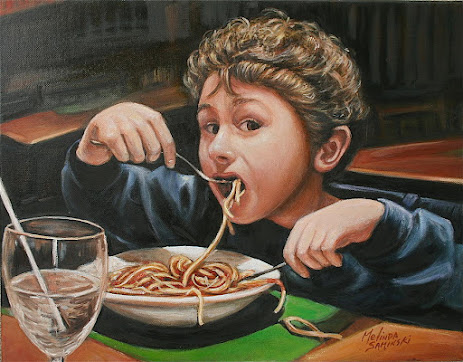
Spaghetti Boy Painting by Melinda Saminski

Thursday, July 19, 2018

History of distillation process in Europe

The first distillation apparatus found in Mesopotamia (today´s Iraq) comes from the period 3500 BC. Nicander (183—135 BC), a Greek poet and physician, spoke of the extraction of perfumes from plants by what should now call as a process of distillation.

The earliest certain chemical distillations were by Greeks in Alexandria in the 1st century AD but these were not distillations of alcohol.

The medieval Arabs adopted the distillation technique of the Alexandrian Greeks, and written records in Arabic begin in the 9th century, but again these were not distillations of alcohol.

Al-Kindi (801-873, wrote in the 9th century a book on perfumes which he named ‘Book of the Chemistry of Perfume and Distillations’. It contained more than hundred recipes for fragrant oils, salves, aromatic waters and substitutes or imitations of costly drugs. The book also described one hundred and seven methods and recipes for perfume-making.

Although there are rare Arab references, towards the end of the first millennium, to the distillation of wine, it seems probable that for religious reasons they did not exploit it. Distillation of alcohol for drinking seems first to have developed in Europe in the twelfth century and thereafter.

The derivations of the words ‘alcohol’ and alambic, from the Arabic word al-koh’l and al-anbiq, indicate that it was from the Islamic word that the practice of distillation first entered Europe. Until the end of the 15th century, distilled wine (aqua vitae) seems to have been used largely as a medicine.

But in 1493, a Nuremburg doctor noted everyone in the city had got into the habit of drinking. As a result, three years later the city authorities forbade the sale of alcohol on feast days. One of the first books on distillation written by J. French has been published in London in 1651.
History of distillation process in Europe

Articles from other webs