Showing posts with label Italy. Show all posts

Wednesday, November 5, 2025

The Venetian Gateway: How Coffee Entered Europe

Venetian merchants played a pivotal role in introducing coffee to Europe through their thriving trade with the Ottoman Empire. As a key hub between East and West, Venice was perfectly positioned to receive exotic goods, and among them was a dark, aromatic beverage that would soon revolutionize European tastes. The first mention of coffee by a Venetian diplomat came in 1573, when the Venetian ambassador to the Ottoman court reported on the popular drink enjoyed in Istanbul’s bustling coffeehouses.

The physical introduction of coffee beans to Venice is credited to Prospero Alpini, a physician and botanist who served the Venetian consul in North Africa, Giorgio Emo. During his travels in Egypt, Alpini carefully studied the coffee plant and its use among the local population. His observations were later published in De Medicina Egyptiorum (1591), one of the earliest European works to describe coffee’s properties. Alpini not only documented the plant’s anatomy but also highlighted its therapeutic qualities, noting its ability to stimulate the senses and aid digestion.

By the early 17th century, coffee had made its way to Venice, initially sold in pharmacies as a medicinal tonic. Apothecaries promoted it as a remedy for fatigue and digestive ailments, catering to the city’s affluent classes. However, its invigorating effects and distinctive flavor soon captured a broader audience. By the mid-1600s, coffee became a fashionable beverage enjoyed for pleasure rather than solely for health.

The first Venetian coffeehouse opened in 1683 in St. Mark’s Square, transforming coffee drinking into a social experience. These cafés quickly became vibrant centers of conversation, art, and politics—precursors to Europe’s later salon culture. Street vendors had once sold the drink, but now elegant establishments welcomed merchants, nobles, and intellectuals alike.

In 1720, the legendary Caffè Florian opened under the Procuratie Nuove in St. Mark’s Square, marking a new era in European café culture. Known then as Alla Venezia Trionfante, it remains one of the oldest operating cafés in the world. Through Venice’s embrace of coffee, this once-exotic beverage spread across Italy and beyond, becoming an enduring symbol of social life, sophistication, and the art of conversation.
The Venetian Gateway: How Coffee Entered Europe

Tuesday, November 26, 2024

The Colosseum: A Timeless Symbol of Roman Engineering and Legacy

The Flavian Amphitheatre, or the Colosseum, remains one of the most enduring symbols of ancient Rome and a masterpiece of Roman engineering. Construction began around AD 70-72 under Emperor Vespasian of the Flavian dynasty and was completed in AD 80 by his son, Titus. Built on the site of Nero's Golden House—an opulent palace constructed after the Great Fire of Rome in AD 64—the Colosseum symbolized a shift from Nero's self-indulgence to the Flavians’ focus on public welfare and entertainment.

This monumental structure was designed to host a variety of public spectacles, reflecting the cultural and political dynamics of the Roman Empire. Events included gladiatorial contests, animal hunts, and even mock naval battles, which were staged by flooding the arena. The Colosseum's design accommodated between 50,000 and 80,000 spectators, with seating carefully arranged to reflect the rigid social hierarchy of ancient Rome. Senators and elites occupied the best seats, while women and lower-class citizens were relegated to the upper tiers.

Architecturally, the Colosseum is a marvel of innovation. Its robust system of concrete and stone vaults and arches provided both strength and stability, allowing the amphitheatre to stand resilient against time and natural disasters. The structure’s exterior was adorned with statues and intricate carvings, showcasing the grandeur of Roman art and engineering. The use of travertine, tuff, and brick-faced concrete highlighted the Romans’ mastery of materials.

Despite enduring centuries of earthquakes, fires, and systematic looting for building materials during the Middle Ages, the Colosseum remains remarkably preserved. Its survival is a testament to the ingenuity of Roman engineering. Designated as a UNESCO World Heritage Site, it now attracts over 7 million visitors annually, making it one of the most visited landmarks globally.

In recent years, preservation efforts have included extensive restoration projects, such as cleaning the facade and stabilizing weakened sections, ensuring the Colosseum’s legacy endures. It continues to inspire awe as a symbol of Rome’s historical, cultural, and architectural achievements.
The Colosseum: A Timeless Symbol of Roman Engineering and Legacy

Tuesday, August 15, 2023

Palermo's History and Development

Founded by the Phoenicians in 736 BC, the city of Palermo takes its name from the Greek expression "all harbour." These Phoenician mariners of antiquity were renowned for their seafaring skills and were primarily focused on trade rather than territorial expansion. They concentrated on controlling strategically positioned ports to aid their navigation.

Initially acting as a stronghold for the Carthaginians, Palermo eventually came under Roman authority after the Carthaginians' defeat. The city was integrated into the Roman Empire and later became a part of the Byzantine Empire, maintaining this status for over a thousand years.

Between 827 and 1071, Palermo was subjected to Arab dominance during the Emirate of Sicily, a period that elevated its status to that of a capital city. This signaled the commencement of a new chapter for Palermo, leading to a rapid transformation into an impressive urban center reminiscent of the grandeur of Cordoba and Cairo. With the city's expansion came the emergence of new districts, including the fortified coastal area known as the Kalsa and the emir's residence.

Following the Norman reconquest, Palermo was designated as the capital of the newly established Kingdom of Sicily (1130 to 1816), later merging with the Realm of Naples to form the Kingdom of Two Sicilies, a union that persisted until the Italian unification in 1860.

Under the rule of Roger II, Palermo, now the capital of the flourishing Norman realm, experienced a period of great wealth and luxury. It became a central hub for trade between the Eastern and Western worlds, attracting nobles, traders, and adventurers who were captivated by the allure of the prosperous city and its splendid court.
Palermo's History and Development

Thursday, January 27, 2022

Early days of processing pasta in Italy

Pasta was consumed in Italy as early as 600 BC. Italy is generally as home of pasta. Italian pastas namely Macaroni and spaghetti are being traditionally made from semolina flour from durum wheat.

The word "pasta" comes from the Italian word "maccarruni" which means "made into a dough by force". In Italian language maccarruni (macaroni) called as "pasta".

During 1270s, there is a reference to a soldier in the northern Italian city of Genoa, who owned a basket of “macaronis.” A century before, the Muslim geographer al-Idrisi wrote of seeing pasta produced on Sicily. He wrote that the art of making spaghetti or the thinner vermicelli, reached Sicily with the North African caravans in about AD 11oo. On that island they found the essential requisites: hard-grain semolina wheat, sweet water and abundant sun and wind to dry the rolled-out product.

In the 1500s dry pasta manufacturers were founded all over the Italy. The dough was mixed by foot and compressed by 3-4 workers sitting on a long wooden pool. The dough was presses into bronze plate as vermicelli, trennette, lasagnette, farfalle, pennette, conchiglie and other pasta forms, still known today.

Pasta’s great companion, the tomato was bought to Italy by the Spaniards and appears to have been grown in Siena in the 1560s and the Naples area in 1596.

The French Dominican monk Jean-Baptiste Labat (1663–1738), who traveled through Italy at the turn of the 18th century, discovered a flourishing pasta industry there. The combination of the manual brake and the extrusion press, which began to spread in the second half of the 16th century, had revolutionized the production of pasta, considerably increasing output without in any way harming quality.
Early days of processing pasta in Italy 
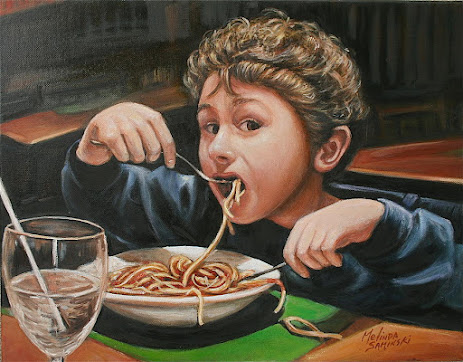
Spaghetti Boy Painting by Melinda Saminski

Wednesday, January 22, 2020

Crotonian Medical School

The date of the founding of the Crotonian Medical School is not known, but as early as the sixth century BC, it had achieved an excellent reputation. Herodotus (circa 484–425 BC) wrote: “the physicians of Crotona had the name of being the best, and those of Cyrêné the second best, in all Greece”.

Croton became a medical metropolis through the distinction of its medical school and the ability of its doctors, of whom Democedes is one of the best known. This famous physician came to Croton from Cnidus in 530 B .C., and remained there until 525 B.C., when his services were retained by Athens as State physician.


Crotonian physicians were considered the first in Greece. One member of the Crotonian school, Alcmaeon, achieved great distinction in both anatomy and physiology. He first recognized the brain as the organ of the mind and made careful dissections of the nerves which he traced to the brain.
Crotonian Medical School

Wednesday, June 14, 2017

Raffaello Sanzio da Urbino

Raffaello Sanzio da Urbino (April 6 or March 28, 1483 – April 6, 1520), known as Raphael, was an Italian painter and architect of the High Renaissance.

His family name was Sanzio: he was born in the city of Urbino, in the pontificate of Sixtus IV. His father, Giovanni Sanzio, was a painter for court of Urbino but of no professional celebrity, he was considered to possess superior judgment.

In the court of Urbino, Raphael was exposed to some of the best artists and thinkers from around the world, Because of his father’s connections in the court, Raphael began training to be an artist.

The great fame of Michael Angelo Buonaroti, and Leonardo da Vinci, induced him to visit Florence and the careful examination of the works of those eminent artists enlarges his ideas and enabled him to improve his style.

After residence of some time at Florence Raphael, was recalled to Urbino by the death of his parents. He remained there to execute some works for the duke and the churches and then return to Florence where he continued his laborers and studies.

His reputation afterwards called him to Rome in 1509, where Pope Julius II, employed him in decorating with frescoes the chambers of the Vatican. Pope hired Raphael as scriptor brevium. It was here that he first displayed the full extent of his admirable genius; and his pictures of the doctors of the churches and the school of Athens are still regarded as some of the most wonderful production of the art.
Raffaello Sanzio da Urbino

Thursday, November 20, 2014

History of wine in Italy

The history of wine in Italy stretches back thousands of years. The Etruscans may well have enjoyed wine. 

The early Etruscans were already producing wine in southern Italy from the 8th to the 4th century BC.

When the ancient Greeks arrived there, wine already existed there.

During the Roman Empire, garum fish sauce with water was a favored drink, and Roman waged naval campaign to secure garum from Spain and North Africa. Because garum was costly Roman legions often had to make do with fermented grape juice shipped to distant outpost.

Rome expands its territory by conquering, where they encounter the Greek colonies. They are exposed to high quality Greek wines, the technology associated with them and the Greek god of wine.

During the Kingdom and much of the Republic, the Greek influence in winemaking and drinking dominated. The preferred wines are sweet with high alcohol content. It has been estimated that the average Roman consumed fourteen liters of wine a month.

Old Roman wines, like wines today, varied from gourmet selections to early undrinkable swill. The Romans add resin, herbs, spices and perfumes to many wines. Often, the purpose is to mask the bad taste of a vinegary wine.

The Romans expanded the era of Europe under vine immensely taking wine and a wine culture with them as they eventually conquered most of the continent.

At the turn of the first century BC, several Roman vineyards gain popularity and respect. The most famous of them is Falernum.

Wine was traded to Gaul from Roman Empire form the 3rd century BC. Wine was particularly in demand from the late 2nd century BC in southern Gaul, where viticulture had not yet been introduced.

Major advancements in viticultural and vinicultural practices were developed by the Roman and they bred many ancestors of today’s top grapes.

After the fall of the Roman Empire, the Catholic Church maintained a wine culture in Italy as it did for the rest of Europe.

With the introduction of more advanced winemaking science and new technologies like the cork to seal bottles, Italian wines became a major force in export markets in the early 1800s.

In 1963, the Italian government introduced laws called the ‘denominazione di origine controllata’ to control wine production. This led to a rise in standards and Italy’s place as one of the world’s leading wine exporter.
In 2006, Italy outproduced France and became the world’s largest wine producing country.
History of wine in Italy

Articles from other webs