Showing posts with label Sweden. Show all posts

Thursday, June 20, 2024

The Historical Evolution of Sweden

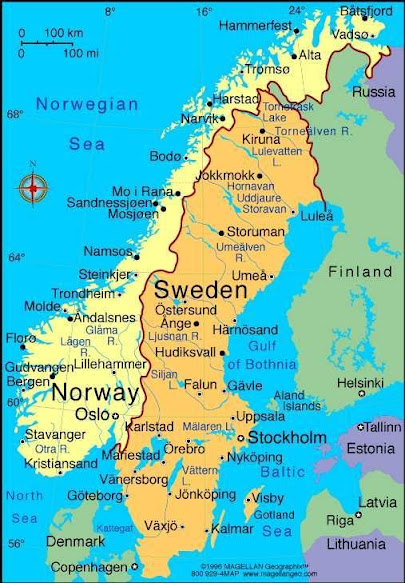
Sweden, a country known for its rich history and cultural heritage, has origins that trace back to ancient times. By the thirteenth millennium BC, central Europe had shed its icy mantle, and the Scandinavian North—including Sweden, Norway, Denmark, and Finland—began to emerge from its cold slumber. As the climate warmed, it fostered an environment where plants and animals could thrive, setting the stage for human habitation.

By 8000 BC, a significant geographical transformation occurred with the appearance of a wide peninsula extending northward from the European continent. This newly formed land bridge facilitated the migration of settlers. Around 7700 BC, larger groups of people from the Danish islands began arriving in the region, drawn by the hospitable climate and abundant resources.

The historical timeline of Sweden is marked by several distinct eras, particularly during the Iron Age (400 BC-AD 1050). This period is typically divided into the Pre-Roman (400 BC-AD 50) and Roman (AD 50-400) periods, the Migration Era (400-550), the Vendel Era (550-800), and the Viking Age (800-1050). Each of these epochs contributed uniquely to the development of Swedish society, culture, and political structures.

A significant milestone in Swedish history was the reign of Erik Edmundsson Segersall, the first Swedish king, who ascended to the throne in 970. King Erik managed to expand his kingdom, at one point even bringing Denmark under his control. He ruled the Svear from 970 to 995 and briefly became king of the Danes around 992-993. His reign marked the beginning of a more unified and powerful Swedish state.

In 1000 AD, Olof, the king of Sweden, achieved a notable victory against Olav Tryggvason of Norway in a sea battle. This victory solidified a kingdom that stretched from the Arctic regions to the Skane-Zealand strait. The Swedish name for Sweden, "Sverige," originates from "Svea Rike," meaning the kingdom of the Svear.

Modern Sweden began to take shape with the formation of the Kalmar Union in 1389, a unification of the three Scandinavian kingdoms, which was confirmed at Kalmar in 1397. However, it was the efforts of King Gustav Vasa in the 16th century that truly unified the country, laying the foundation for the Sweden we know today. His leadership not only consolidated Swedish territories but also initiated a period of significant cultural and political development.
The Historical Evolution of Sweden

Tuesday, October 20, 2020

Predecessor State Of Modern Finland: Grand Duchy Of Finland

Grand Duchy of Finland existed between 1809 and 1917 as an autonomous part of the Russian Empire.

Since the thirteenth century, Finland had been under Swedish rule, administered by Swedish speaking nobles and bureaucrats. In the early 14th century Novgorod (Russia) and Sweden battled in Finland and consequently by 1323, western and southern parts of Finland were merged with Sweden and the eastern part of Finland, Karelia, became part of the Russo-Byzantine world.

Resulting from the successful military efforts of Alexander I of Russia (1777–1825) in 1809, Finland became a part of the Russian empire. As part of the Russian empire, Finns were promised autonomy under the Russian tsars and became Grand Duchy of Finland.

Emperor of Russia, Tsar Alexander I convinced of the strategic need to control Finland for the protection of his capital at St. Petersburg. He determined it was more expedient to woo his Finnish subjects to allegiance than to subjugate them by force. He granted it an autonomous status within the empire.

The Grand Duchy of Finland became part of Russia through personal union as an autonomous region of the Empire with its own government, parliament, currency and army.

The situation changed already during the rule of Alexander III. In 1890, Alexander III initiated a series of efforts aimed at bringing Finland under tighter Russian control. After Alexander’s death and the accession of Nicholas II (1868–1918) to the throne, period of Russification continued and expanded throughout the Russian empire including Finland. In 1899 when Finnish legislation came under the purview of the Russian government, it started the first “years of oppression”.

Finland take advantage of the October Revolution to break away from Russia and announced independence on 6 December 1917. These events were accompanied by a severe political crisis and on January 27/28, 1918, civil war finally erupted. The Red Guards took control capital of Finland, Helsinki and declared a revolutionary government, the People’s Commission (Kansanvaltuuskunta), headed by Kullervo Manner (1880–1939).
Predecessor State Of Modern Finland: Grand Duchy Of Finland

Tuesday, December 24, 2013

The beginning of Sweden

By the thirteenth millennium BC central Europe had been freed of its cold burden, and the Scandinavian North (Sweden, Norway, Denmark and Finland) slowly to be uncovered. The climate became warmer, allowing plants and animals to flourish.

By 8000 BC a wide peninsula of land appeared extending northward from the continent.

Around 7700 BC the settlers arrived in larger numbers from the Danish islands in the south via the land bridge to Scandinavia.

The Swedish Iron Age (400 BC-AD1050) is typically divided into Pre-Roman (400 BC-AD50) and Roman (50-400) periods, the Migration Era (400-550), the Vendel Era (550-800) and the Viking Age (800-1050).

Erik Edmundsson Segersall is the first Swedish king and become king in 970. He managed to expand his kingdom, even bringing Denmark under his command.

Erik was king of the Svear form 970 to 995, and also king of the Danes, but only for a year, approximately 992-993.

In 1000, Olof, king of Sweden, had defeated Olav Tryggvarson of Norway in sea battle, successfully defending a kingdom stretching from the arctic to the Skane - Zealand strait.

The Swedish name for Sweden is Sverige and stems from Svea Rike, of the kingdom of the Svear. Modern Sweden started out of the Kalmar Union, (union of the three Scandinavian kingdoms, established in 1389, solemnly confirmed at Kalmar in 1397) and by the unification of the country by King Gustav Vasa in the 16th century.
The beginning of Sweden

Articles from other webs