Showing posts with label founder. Show all posts

Monday, October 31, 2016

The rise of Knight Templar

The most influential organization the medieval Western world has ever known, the Order of the Temple (1119-1312) was the first military-religious Order of the Western Church, a ‘new knighthood’.

Its member were not only powerful monastic warriors, but also international banking experts, agriculture land owners and developers, seasoned diplomats, businessmen, advisors to popes and kings, guardians of assets, ship owners, and much more.

The order had existed since about 1094 with Hugues de Payens as head of it from day one. He was pious, and he went out to the Holy Land, with the First Crusade around 1096.

He was distressed by the plight of the pilgrims seeking to obtain divine grace and favor by visiting the Holy Palaces of Jerusalem. They landed mostly at Jaffa and found the Promised Land without shade, water or shelter.

Hughes de Payens proposed to create a volunteer escort to protect and assist the pilgrim bands from shipside to their goal. And this was his great idea – to enroll volunteers in a monastic order of men-at-arms, the Poor Knights of Christ.

Not long after the Templars became established in Jerusalem, it founders returned to Europe to request aid in the form of both manpower and materials. Eventually, the Poor Knights of Christ were renamed the Templars.

In 1129 at Council of Troyers, the Order was officially endorsed by the Catholic Church. With this formal blessing, the Templars became a favored charity across Europe, receiving money, farmland, businesses, property and noble-born sons from families who were eager to help with the fight to secure the Holy Land.

As the Templar organization matured, it became one of the most successful institutions of the Middle Ages.
The rise of Knight Templar

Tuesday, December 24, 2013

The beginning of Sweden

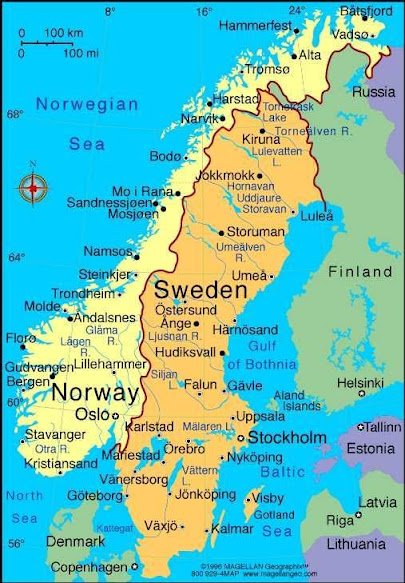
By the thirteenth millennium BC central Europe had been freed of its cold burden, and the Scandinavian North (Sweden, Norway, Denmark and Finland) slowly to be uncovered. The climate became warmer, allowing plants and animals to flourish.

By 8000 BC a wide peninsula of land appeared extending northward from the continent.

Around 7700 BC the settlers arrived in larger numbers from the Danish islands in the south via the land bridge to Scandinavia.

The Swedish Iron Age (400 BC-AD1050) is typically divided into Pre-Roman (400 BC-AD50) and Roman (50-400) periods, the Migration Era (400-550), the Vendel Era (550-800) and the Viking Age (800-1050).

Erik Edmundsson Segersall is the first Swedish king and become king in 970. He managed to expand his kingdom, even bringing Denmark under his command.

Erik was king of the Svear form 970 to 995, and also king of the Danes, but only for a year, approximately 992-993.

In 1000, Olof, king of Sweden, had defeated Olav Tryggvarson of Norway in sea battle, successfully defending a kingdom stretching from the arctic to the Skane - Zealand strait.

The Swedish name for Sweden is Sverige and stems from Svea Rike, of the kingdom of the Svear. Modern Sweden started out of the Kalmar Union, (union of the three Scandinavian kingdoms, established in 1389, solemnly confirmed at Kalmar in 1397) and by the unification of the country by King Gustav Vasa in the 16th century.
The beginning of Sweden

Articles from other webs