Showing posts with label Viking. Show all posts

Sunday, March 31, 2024

The Viking Peoples: Raiders, Conquerors, and Colonists of Western Europe

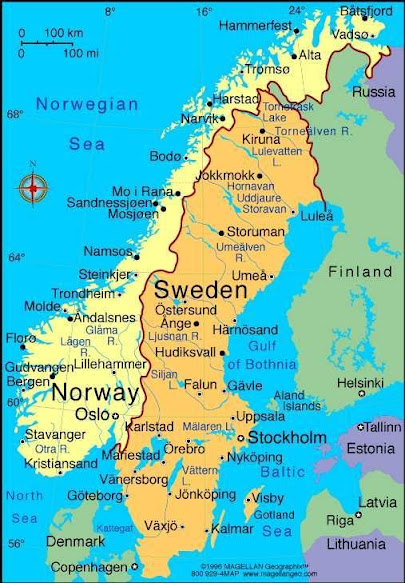
From the eighth to the eleventh centuries, Scandinavians, primarily Danes and Norwegians, left an indelible mark on the history of Western Europe as raiders, conquerors, and colonists. Emerging from what are now Denmark, Norway, and Sweden, these peoples inhabited the northern European region known as Scandinavia, characterized by its two peninsulas and myriad islands.

Men and women from western Scandinavia embarked on daring journeys, settling not only in regions of the British Isles under Scandinavian control but also in the previously uninhabited Faroe Islands and Iceland in the Atlantic. Their migration patterns were driven by a quest for new lands to conquer and inhabit, marking them as one of the most dynamic and feared peoples in Europe during their time.

The Viking reputation for violence and prowess in battle spread across Europe as they conducted raids, encountering various appellations from the peoples they encountered. Anglo-Saxons referred to them as ‘pagans’, ‘Danes’, or ‘Northmen’, while Frankish sources dubbed them Northmen or Normans, and German chronicles labeled them as Ashmen. Spanish Muslim sources referred to them as al-Madjus, Slavic sources as Rus, and Byzantine sources as Rhos.

Although the term "Vikings" gained broader usage in the ninth century, originally denoting raiders from Scandinavia, it now encompasses many aspects of Scandinavian society during what is commonly known as the Age of the Vikings. Their prowess in combat was legendary, leading to the consolidation of Denmark, Norway, and Sweden into Christian realms from previously fragmented chieftains and principalities.

The influence of the Vikings extended beyond Europe. Norsemen colonized Iceland, Greenland, and parts of North America, while also establishing trading networks and settlements in the British Isles and northwestern mainland Europe. Viking traders and leaders exerted significant influence in regions as far-reaching as Russia.

The Viking presence in England began with raids along its coasts in 793, initially focused on looting before evolving into full-scale invasions. In 865, a formidable Viking army swept through England, marking a pivotal moment in their interactions with the Anglo-Saxon kingdoms.

In summary, the Viking peoples of Scandinavia left an enduring legacy as raiders, conquerors, and colonists across Western Europe and beyond. Their influence reshaped political landscapes, cultural dynamics, and trade routes during the tumultuous period known as the Age of the Vikings.
The Viking Peoples: Raiders, Conquerors, and Colonists of Western Europe

Tuesday, February 13, 2024

Danes: Rich History, Culture

The Danes, as an ethnic group and nationality indigenous to Denmark, possess a profound historical significance deeply interwoven with the country's essence. Technically, the term "Dane" primarily refers to the Vikings originating from Denmark, distinct from their Norwegian counterparts known as "Norse." These Vikings played a pivotal role in establishing what eventually developed into the Kingdom of Denmark, with the name of their realm, believed to signify "Danish March," reflecting the southern border region known as the Danevirke.

Defined as Nordic Scandinavians, Danes often exhibit characteristic features like blond hair, blue eyes, and towering stature, although traces of German ancestry are observable in southern regions. Their lineage can be traced back to the earliest settlers, who, as hunters and fishermen, are thought to have migrated from Southern and Eastern Europe around 10,000 BC, marking the conclusion of the last Ice Age.

The transition to settled agricultural life commenced approximately by 3000 BC, as farms began to emerge on the fertile plains of Denmark. Initially utilizing stone tools, inhabitants swiftly embraced advancements in bronze and iron technology, laying the foundation for a thriving Iron Age society.

During this period, Danes forged significant trade connections with the Roman Empire, engaging in the exchange of prized commodities such as animal furs and amber. By 200 AD, the Danish people had adopted the Rune language, evidenced by inscriptions carved in stone throughout the region, serving as enduring remnants of their linguistic heritage.

In essence, the Danes symbolize resilience, adaptability, and cultural wealth, embodying a legacy that spans millennia. From their humble origins as nomadic hunters to their ascent as respected seafaring warriors and shrewd traders, the Danes have left an enduring imprint on history, significantly shaping the trajectory of Denmark and influencing the broader narrative of European civilization.
Danes: Rich History, Culture

Tuesday, October 1, 2019

Swords in Medieval time

Swords have fascinated people for centuries. The reason for that is perhaps the romantic light that has been cast on them by authors through the years or perhaps by the power associated with them. Swords have been a symbol of power and strength throughout the world from ancient times and this did not change until swords became militarily redundant with the advent of more advanced firearms.

The spatha, the long sword of the Romans, was in essence similar to the swords used throughout the Middle Ages. Longsword is a sword especially favored by early medieval barbarian soldiers usually of simple broad shape. These swords could be single or double edged with a rounded point made for slashing and cutting rather than thrusting.

It was a weapon that was useful on foot and on horseback, against unarmored or heavily armored opponents. The longsword could be held with one or two hands on the hilt to slash, or held at the half-sword for thrusting. It could even be turned around and swung as a hammer.

Viking warriors took justifiable pride in their swords. They were expensive and well made, some crafted by smiths who signed their work down the middle of the blade. They were made from iron welded together and then twisted and remade, and then twisted and remade again, over and over until the strongest blade was achieved.

The sword was the close-combat weapon of choice for almost all barbarian soldiers, both cavalry and infantry. While the Romans preferred the short gladius, which was used primarily for thrusting, the barbarians chose the longer spatha, which was both a slashing and a thrusting weapon.

The Viking swords, which evolved from the Roman long double-edged sword ( spatha) and whose evolution stages are nowadays relatively well-known, the different types of swords had been in use in the eastern Mediterranean and Byzantium.

The swords in Byzantium until the 12th century were of more diverse forms as a result of various influences and traditions meeting there. In addition to the Roman tradition, which resulted in using the long sword (spatha) and short sword (gladius) mentioned in the armament of the Byzantine cavalry in the beginning of the 10th century various sword types were also the result of influences from the west, of the barbarian tribes during Great Migration (Herules), the Slavic and Viking mercenaries in the Early Middle Ages and also from the east, rst of all from Persia and sometime later from Syria.

Swords in Medieval time

Thursday, September 14, 2017

The history of Normans

The Normans were the people of Normandy, the north-western province of France that came into existence at the beginning of the 10th century. They are the band of Vikings that laid the foundation for the duchy of Normandy.

It started in the year of 911, at the so-called treaty of St Clair-sur-Epte. At that time and place Charles the Simple, king of the Wests Franks evidently granted territory about the lower Seine and the city of Rouen to a band of Viking led by one Rollo.

The term ‘Viking’ is rarely used in medieval Europe, a word which evoked fear and distrust in the minds of Europeans.
Normans name derives from ‘north men’, which means ‘men who came from the north’, and etymology that was well understood by the Normans themselves.

Despite the hostility of their neighbors, the Normans assumed Frankish ways: they accepted the religion, the language and the women of the Franks.

From Normandy they set out later to conquer southern Italy and the greater part of Britain and some established themselves elsewhere in Europe.

In the 11th and 12th centuries, the Normans, as they came to be known in English, became a people renowned throughout their new Frankish homeland and indeed, in an area stretching from Ireland to the Holy Land. 

In the west, the Normans became the conquerors of England, after their successful invasion of 1066.

The Normans involvement in southern Italy began in 1013 at the shrine of St Michaels on Monte Gargano, when a Latin rebel against Byzantium authority in southern Italy, Meles, invited the Normans to serve him as mercenaries.

In the 1090s, Norman’s forces were instrumental participants in the First Crusade both in the journey to and capture of Jerusalem and in relations with the Byzantium emperor of the time, Alexius Commnenus.
The history of Normans

Wednesday, February 18, 2015

Ancient history of Isle of Man

The Manx are people of the Isle of Man. They are descended in large part from the Celts. The Isle of Man is neither part of the modern political state of the United Kingdom nor part of Great Britain. Rather, it is a self governing British Crown dependency and like Canada and Australia, a member of the Commonwealth of Nations.

The earliest known inhabitants of the Isle of Man have been identified as Middle Stone Age hunter-gatherers from 7000 BC, by which time the climate had improved enough from earlier Ice Age conditions to allow subsistence. They arrived in the transitional period and the beginning of agriculture in the Middle East.

By 4000 BC people on the Isle of Man had became farmers.
Isle of Man

The arrival of the Celts around 200 BC was a most important event in the island’s history.  Isle of Man was never incorporated into the Roman Empire, but the island was noted in Greek and Roman Accounts.  Around the 5th century Christianity arrived with monks from Ireland.

The Norseman broke as raiders into the Celtic Christian community of the island in 798 and by about a century later there are signs that Norse farming colonists or their children were receiving Christian burial in graveyards adjacent to keeills (churches). The Isle of Man became a ‘Viking flair’ form which attacks were launched on the neighboring coasts.

Scottish kings fought the Viking Norse on Man and the surrounding islands, and in 1265 what was known as the Kingdom of Man and the Isles was transferred to Alexander II of Scotland.
Ancient history of Isle of Man

Tuesday, December 24, 2013

The beginning of Sweden

By the thirteenth millennium BC central Europe had been freed of its cold burden, and the Scandinavian North (Sweden, Norway, Denmark and Finland) slowly to be uncovered. The climate became warmer, allowing plants and animals to flourish.

By 8000 BC a wide peninsula of land appeared extending northward from the continent.

Around 7700 BC the settlers arrived in larger numbers from the Danish islands in the south via the land bridge to Scandinavia.

The Swedish Iron Age (400 BC-AD1050) is typically divided into Pre-Roman (400 BC-AD50) and Roman (50-400) periods, the Migration Era (400-550), the Vendel Era (550-800) and the Viking Age (800-1050).

Erik Edmundsson Segersall is the first Swedish king and become king in 970. He managed to expand his kingdom, even bringing Denmark under his command.

Erik was king of the Svear form 970 to 995, and also king of the Danes, but only for a year, approximately 992-993.

In 1000, Olof, king of Sweden, had defeated Olav Tryggvarson of Norway in sea battle, successfully defending a kingdom stretching from the arctic to the Skane - Zealand strait.

The Swedish name for Sweden is Sverige and stems from Svea Rike, of the kingdom of the Svear. Modern Sweden started out of the Kalmar Union, (union of the three Scandinavian kingdoms, established in 1389, solemnly confirmed at Kalmar in 1397) and by the unification of the country by King Gustav Vasa in the 16th century.
The beginning of Sweden

Tuesday, September 24, 2013

The Viking people

From the eight century to the eleventh, Scandinavians, mostly Danes and Norwegians, figure prominently in the historians of Western Europe as raiders, conquerors and colonists.

They came from what are now Denmark, Norway and Sweden nations that only took shape later during the medieval period. They are located in the northern European region known as Scandinavian which occupies two peninsulas and hundreds of islands.

Men and women from west Scandinavia emigrated to settle, not only in the parts of the British Isles that were then under Scandinavian control, but also in the Faeroes and Iceland, Atlantic islands that previously been uninhabited.

During that time, they were one of the most dynamic and feared peoples in Europe. They sailed from their own countries in search of new lands to conquer and to settle.

Their raids across Europe gave them a reputation as violent warriors.

The people these Scandinavians encountered gave them a variety of names. To the Anglo-Saxon; the Vikings were ‘pagans’, ‘Danes’ or ‘Northmen’. Frankish sources too refer to them as Northmen or Normans; while German chronicles describe them as Ashmen.

Spanish Muslim sources refer to them as al-Madjus; Slavic sources as Rus and Byzantine sources as Rhos.

In the ninth century it was only English who occasionally, called the invaders Vikings, a Scandinavian word that now has a wider meaning and is used to describe many aspects of Scandinavia society in what is commonly called the Age of the Vikings.

The fighting skill of the Vikings was legendary across Europe. During the Age of Vikings, the nations of Denmark, Norway and Sweden were molded out of small chieftains and principalities and became Christian realms.

Iceland, Greenland and a section of North America were colonized by Norsemen who also raid and settled in parts of the British Isles and northwestern mainland Europe. Viking traders and dynasts loomed large on Russian soil.

They arrived on the British coasts in 793 and looted the places they attacked and took the booty home. Eventually the raids turned into an invasion and in 865 a large Viking army swept through England.
The Viking people

Articles from other webs